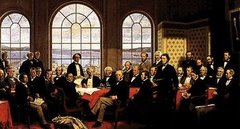
Definitely short and sweet. To date in 2007, the Nova Scotia legislature has sat for less than five weeks.
The Chronicle Herald remarks that while sitting days have fallen, MLA salaries have gone up. I'm fine with that. They'd be worth $200,000 each if it means getting sitting days down to a week.
It's silly to believe that debate in the legislature means anything. Everything is decided beforehand. It's better we influence them when they're back in their constituencies, ready to discuss, away from the temptation of sound bites to the Province House media.
The less politicians sit, the less they'll feel the urge to create new spending programs and new regulations. That's how to get our money's worth from our legislature.
Wednesday, April 18, 2007
Tuesday, April 17, 2007
Dion Would Reinstate Court Challenges
Stephane Dion said today that if elected he would reinstate the Court Challenges Program. He connects it with strengthening the Charter.
The CP describes the program as one that helped pay for lawsuits seeking to expand government provided benefits. Strange isn't? I thought it was the job of elected officials to do that. This is a democracy after all.
It doesn't matter to Dion that judges decide things, because it's been his party that's been stacking the benches for 13 years. As if Canadians trust politicians to be "fair and non partisan" in anything, let alone judicial appointments. Fair and non partisan means lots of Liberals and a few friendly Tories to keep the media at bay.
And if Liberals were so concerned about helping interest groups bring challenges to the government, why don't they voluntarily donate? I wonder how much him and his pals give to legal charities. Well... why use money out of their own pockets, when taxpayer money can be used.
The Court Challenges Program consolidates power in unelected judges and the elite lawyers who argue before them. It must not come back.


Politicians Vow More Authoritarian State
The Virginia Tech shooting is a tragedy. It is also the platform on which even the Canadian left has now jumped on to propose a more authoritarian state.
Deputy Liberal Leader Michael Ignatieff called for action to prevent future shootings in Canada. Translated, that means give the government more power and submit yourselves to more dependence. Left wing, activists are more overtly calling for "power to the state":
Deputy Liberal Leader Michael Ignatieff called for action to prevent future shootings in Canada. Translated, that means give the government more power and submit yourselves to more dependence. Left wing, activists are more overtly calling for "power to the state":
As MPs remain divided on a plan to scrap the federal gun registry, Wendy Cukier of the Coalition for Gun Control said the massacre serves as a sobering reminder of the need for strict gun control measures. The prevalence of shooting deaths in the U.S. is directly linked to the availability of firearms, she said.More like, the prevalence of shooting deaths at Virginia Tech yesterday is directly linked to the helplessness of the victims. Ms. Cukier wants Canadians to be just as dependent on the state in the event of shootings at their schools. No thanks.
Monday, April 16, 2007
Subsidy Lets Nova Scotia Call Centre Expand
Through a $914,000 "payroll rebate" from the Nova Scotia government, a Cape Breton call centre is hiring up to 175 new full timers. Great for the company, ServiCom Canada Ltd., but just how did they get chosen for such a break? As if it's special news that free money lets a company expand.
Of course, Premier Rodney MacDonald is very happy about this as he is from Cape Breton. In normal situations, the blogger would slyly ask if that's a coincidence, but not in Nova Scotia. Subsidized businesses are a fact of life here.
Giving government agencies such as Nova Scotia Business Inc. the power to choose subsidies hands too much power to government. This is a case as clear as any where government dependency is created. And it's no doubt political. Support a certain government and get goodies. The NDP and Liberals? Just as bad.
It's frustrating that the press lifts words off government talking points. The government calls it "help" as if it's out of compassion. Well, it's not quite help, it's more like diverting the tax burden to others. It's help if you turn a blind eye to others who are taxed to compensate for this. As if this helped them (everyone else). Thanks a lot media.
Sunday, April 15, 2007
Sarkozy's Message to Expats
A message from leading French presidential candidate Nicolas Sarkozy.
I'm still curious... if Stephane Dion had kept his French citizenship would he have voted for Sarkozy or Segolene Royal? Probably the Socialist...
More from the Economist.
(HT)
I'm still curious... if Stephane Dion had kept his French citizenship would he have voted for Sarkozy or Segolene Royal? Probably the Socialist...
More from the Economist.
(HT)
Saturday, April 14, 2007
Court Releases Suspected Terrorist
The Federal Court of Canada yesterday released a senior terrorism suspect back to his home in Toronto, where he will be supervised by his son. Mahmoud Jaballah, has been in detention without charge for the past six years and Madame Justice Carolyn Layden-Stevenson took this into consideration when giving her order for bail surety. The Globe and Mail reports on the conditions:
One can only presume that those 20 would be in addition a few other officers already assigned to them. After all, these two men have to be watched 24 hours a day by armed teams who also monitor all their communications and watch for leads they might generate. How much does that cost? It can only be thousands of dollars a day, in addition to the lost manpower on the streets of Toronto. Perhaps these 20 odd officers should be out hunting for other suspects instead of babysitting a known danger. Perhaps he should be back in jail.
Or perhaps not. Courts err under the traditional criminal law maxim that "it is better to have ten guilty men go free than one innocent man punished". In the criminal sense, that's still the best policy. But is it still fitting when dealing with terrorists? Where one man may go free to kill a hundred? This is one policy question Canadians need to deal with sooner rather than later.
Mr. Jaballah's house arrest will be strict, his communications will be closely monitored and federal agents will follow him whenever he leaves his home.A source yesterday suggested immigration-control officials in Toronto are preparing to lobby for as many as 20 new enforcement positions, just to keep tabs on Mr. Jaballah and the newly released Mr. Mahjoub, an Osama bin Laden associate.
While it is not comforting to know that people can be detained without charge for years, terrorism brings new challenges to the criminal justice system. Arguably, they should not even fall into the criminal category, especially if these terrorists consider themselves soldiers in a war (so they would prisoners of a war they're waging on us). Nevertheless, taking on 20 new officers to keep tabs on two suspected terrorists is quite a notable number.
One can only presume that those 20 would be in addition a few other officers already assigned to them. After all, these two men have to be watched 24 hours a day by armed teams who also monitor all their communications and watch for leads they might generate. How much does that cost? It can only be thousands of dollars a day, in addition to the lost manpower on the streets of Toronto. Perhaps these 20 odd officers should be out hunting for other suspects instead of babysitting a known danger. Perhaps he should be back in jail.
Or perhaps not. Courts err under the traditional criminal law maxim that "it is better to have ten guilty men go free than one innocent man punished". In the criminal sense, that's still the best policy. But is it still fitting when dealing with terrorists? Where one man may go free to kill a hundred? This is one policy question Canadians need to deal with sooner rather than later.
Friday, April 13, 2007
Nova Scotia High School Math Results
72% of English schooled Nova Scotian Grade 12 students failed the provincial math assessment, according to this year's Ministers Report to Parents. The Chronicle Herald reports:
Without a foundation in math, we end up with dozens of economic development boards that do more harm than good. We have people who stand by as spending outstrips revenue year after year. Since so many fail math, Nova Scotians just don't comprehend how much debt they put their children into. It isn't even possible to talk to people about the importance of capital formation, multiplier effects of banks, free trade, etc.
Another interesting fact is that 41% of English students took the advanced math exam, even though it is meant for the top 20% of students who head into the sciences or engineering. In other words, too many kids think they're smart and teachers are afraid to demote students to more appropriate levels. It makes me wonder how many unqualified students roam the halls of universities today, deflating the worth of degrees for everyone else.
Only 28 per cent of students in English schools passed the Grade 12 provincial math exam in 2005-06, down from 31 per cent the year before, say results released Thursday by Education Minister Karen Casey.The average mark was 39 per cent in regular math, a drop from 41 per cent in 2004-05. Students taking advanced math fared a little better — 52 per cent passed, compared to 57 per cent in 2005. The average mark for the advanced students was 51 per cent, down from 54.
Should we be concerned? Yes. I for one am very concerned. High school math is necessary for citizens to evaluate the economic policies of their political leaders. It is my belief that if more students understood math, Nova Scotia wouldn't be in the economic hole it is in today.
Without a foundation in math, we end up with dozens of economic development boards that do more harm than good. We have people who stand by as spending outstrips revenue year after year. Since so many fail math, Nova Scotians just don't comprehend how much debt they put their children into. It isn't even possible to talk to people about the importance of capital formation, multiplier effects of banks, free trade, etc.
Another interesting fact is that 41% of English students took the advanced math exam, even though it is meant for the top 20% of students who head into the sciences or engineering. In other words, too many kids think they're smart and teachers are afraid to demote students to more appropriate levels. It makes me wonder how many unqualified students roam the halls of universities today, deflating the worth of degrees for everyone else.
Thursday, April 12, 2007
Supreme Court Turns Down Chance to Legislate
The Supreme Court of Canada denied leave to appeal for a group of Ontario parents seeking funding for their autistic children.
Good thing, too. It's not a good sign for democracy when people go to judges to get funding. The proper way to do it is to get Dalton McGuinty to pass legislation or regulations to directly fund the specialized treatment.
Either that, or McGuinty should lead the charge to remove the ban on private health insurance. Then maybe these kids would never have been put into this position. But let's not kid ourselves. Ontario Liberals would rather protect a flawed institution than suffering kids.
Questions for the NS Tories
It's not a good press day for the Nova Scotia Tory government.
Leading off, we have news that last year's budget went $120.2 million over. Cabinet gave itself approval of the appropriations. Nobody expects budgets to be exact year after year, but 9 digits is quite a ways off. It makes one wonder if that's just a secret way of creating spending. And let's not forget to ask: is the budget still balanced?
Columnist Marilla Stephenson, a fair critic of the government, makes a good charge that the government is weak under fire. Last week, the government announced the end of mandatory retirement, an excellent plan. As universities fired back for the expense it would create, the plan was delayed. Then there's the ATV licensing plan (bad to begin with) that also just got altered. This reminds us about the smoking rooms in bars plan, only to see all smoking banned. Or the cancellation of the adult recreation tax rebate. What's going on? Yes, as Stephane Dion reminds, it's not easy to set priorities, but stick to them after setting them.
At least there's a nice story about Premier Rodney MacDonald joining the Facebook bandwagon (348 friends and counting).
These guys are all we have. They'd better get their ship in order. The alternative is no alternative.
Wednesday, April 11, 2007
Segregated Military Bases
Shame on Liberal defence critic Dennis Coderre for calling for a segregated military base for native Canadians. Multiculturalism has so gripped Canada that people can't even see that separate isn't equal. Should we go back to black or native only combat units as well?
Is it about sensitivity or recruitment? Or both? It doesn't matter. Segregating the military is no solution.
Mr. Coderre supports this, not realizing the problem in his sponsor's statement. That natives are joining the armed forces in the US is not because there are native bases there. If this were about recruitment, then investigate why US forces are more attractive to join."I think that we have to show sensitivity since Canada is also composed of First Nations," Coderre said. "The Canadian Forces have always reflected what Canada is."
The idea was first floated by Serge Noel, a local resident who noticed that many natives from the area were crossing the border to join armed forces in the U.S.
"The Canadian Forces have taken steps in the past to attract more aboriginals to their ranks and have achieved a certain level of success, but not as much as they would have hoped for," Noel said.
Is it about sensitivity or recruitment? Or both? It doesn't matter. Segregating the military is no solution.
Tuesday, April 10, 2007
New Formula or Old, Nothing Will Change
Governments, not people, benefit in the great Canadian equalization scam. That's my take and I believe it's more or less what Charles Cirtwill, acting President of the Atlantic Institute for Market Studies, writes in a Chronicle Herald op-ed today. He concludes:
If the government really wanted to turn Nova Scotia around, it would use equalization as a buffer for taxes, not spending. We ought to take the trade of a few years of sub comparable services for sub comparable taxes. Give reason for the economy to grow. Give reason for businesses to start or move here.
But Nova Scotians don't want to go the hard way. So who is Premier Rodney MacDonald to lead the other way? Spending more money may help governments stay in power, but it doesn't help the province out of poverty. And so, we trade a few piddling social services for our entire future.
The federal government met its commitment to bring equalization back to a stable, predictable formula. The problem is that the prediction inflates federal costs and expands provincial demands, with little in the way of evidence that either of those things will deliver the "reasonably comparable levels of service" promised in the constitutional guarantee of equalization.
One thing is certain: Both sides are wrong.
The old approach of special accords and side deals had to go. But non-renewable natural resources will never slingshot a province, any province, off of equalization as long as those resources are included in the equalization formula. Worst of all, the new formula is sufficiently attractive that few provinces will resist it for long; and that means we better get used to "have-not" status around here, just beggars along for the ride.
What does he mean? Well, Nova Scotia doesn't want its resource non-renewable revenues included in equalization. No province would. Fortunately, the province has a good excuse: it's a have-not province that needs to use the revenues to become self sufficient.
Too bad the province has shown weak resolve in moving towards self sufficiency. The 2007-2008 Nova Scotia budget included an unsustainable spending increase of more than +6%. It was balanced only because Nova Scotia had more federal transfers.If the government really wanted to turn Nova Scotia around, it would use equalization as a buffer for taxes, not spending. We ought to take the trade of a few years of sub comparable services for sub comparable taxes. Give reason for the economy to grow. Give reason for businesses to start or move here.
But Nova Scotians don't want to go the hard way. So who is Premier Rodney MacDonald to lead the other way? Spending more money may help governments stay in power, but it doesn't help the province out of poverty. And so, we trade a few piddling social services for our entire future.
Monday, April 9, 2007
No Such Thing as Optimal Temperature
"Looking back on the earth's climate history, it's apparent that there's no such thing as an optimal temperature—a climate at which everything is just right. The current alarm rests on the false assumption not only that we live in a perfect world, temperaturewise, but also that our warming forecasts for the year 2040 are somehow more reliable than the weatherman's forecast for next week.So writes MIT Professor Richard S. Lindzen in a must read article on leadership and the environment in this week's Newsweek. The level of dialogue in Canada hasn't quite reached that level. Here, we talk as if cutting back our 2% of global emissions share to 1.4% will single handedly save the world from impending doom.
Then and Now
There were nearly 11,000 Canadian casualties at Vimy Ridge. A tragic number notwithstanding that the force was 20,000 in number.
We salute the men and women of that generation. Did they give up saying too many were lost? That its not worth it? No. They stayed in the fight until it was over.
That was 90 years ago. Today, all it takes is 6 Canadian Forces volunteers who die in Afghanistan to make people question an entire mission. What happened?
Vimy Ridge was a legendary "nation building moment" for us, as the Chronicle Herald notes. It is only fitting that we hang in with a little more resolve to play a role in the nation building of Afghanistan.
Wolfville's Fair Trade Scam
Wolfville, Nova Scotia is about to become Canada's first "Fair Trade" town. I guess they care a lot about feeling good but very little about the workers negatively impacted by fair trade.
Fair trade is a scheme by rich communities to pat themselves on the back for buying higher priced goods. The theory is that products of low paying work is exploitive so if they refuse to buy from those low paying sources, the workers there somehow benefit.
The problem is, there's no proof that fair trade actually makes non fair trade employers in the third world pay employees more. When low paid workers lose their jobs because their employers move elsewhere, they actually get no pay at all. Or maybe they pay some workers more and work them harder, while firing the others. Some pay is better than no pay.
Of course, by then towns like Wolfville are long gone from the scene. And the workers? Well, as they say: out of sight, out of mind.
Elected Judges
63 percent of Canadians are in favour of elected judges, while 30 percent oppose the idea according to a new Strategic Counsel poll. Count me in the 30, though that doesn't mean I like the current system. Judges watch legislators, but who watches the judges? I can't buy that they watch themselves.
This story is also interesting because the report immediate turns to a comparison with the United States and their tradition of electing low level judges. Why does the article not mention that appellate justices--the ones that really matter--in the United States, are not elected? And what of other countries in the world? The world is bigger than the United States.
Moreover, world scenarios demonstrate that giving power to legislators to appoint judges is not without problems either. Would the people of Zimbabwe be justified in opposing Robert Mugabe appointees? Yes. Is it out of the question that Canada's government could grow that large and invasive? No.
Saturday, April 7, 2007
Michael Savage's Coercive Benevolence
Today's Chronicle Herald features a fluff piece about Dartmouth Cole-Harbour MP Michael Savage, whose political philosophy is to "help people who need help and not those who don't."
Going deeper, Liberalism's weaknesses show through. In particular, the claim of helping people in need is questionable because of how that help is funded. Liberals neglect that tax dollars are the result of coerced government actions. Give the state money or the state will put you in prison.
So while, helping people is a noble goal, helping people using the proceeds of force is not. If I gave the pan handler at the intersection $50, you would hardly commend me for being generous if it's because I threatened 50 people with jail unless they gave me $1. When the taxman does it, backed by majoritarian government decree, it doesn't make it right either. This is not to say that no taxation is justified, but it is to say helping people is not quite the description of actions that originate from oppression.
Moreover, while Liberals such as Mr. Savage decry a "disgraceful lack of concern" by the state, individual concern seems to be exempt. If the state does not meet a perceived funding gap, individuals are not precluded from meeting the shortfall. Imagine that every concerned Liberal (or New Democrat) voluntarily donated 5% of his or her income to the groups they allegedly care so much for. They could. But don't. In fact a smaller proportion of Canadians, in all our left leaning compassion, donate to charity than Americans.
Encouraging the state to rob Peter to help Paul is like cheering for totalitarianism. Keep the state out of our lives and let individuals who are interested in helping help out of their own free wills.
Reports Sherri Borden Colley at Mr. Savage's nomination meeting:
At the superficial level, Mr. Savage's rhetoric is reasonable. Helping people in need is unopposable. And it's true enough that Jim Flaherty's budget does not have boosts in funding to many "least fortunate" interest groups.But today, for perhaps the first time in generations, "we have a federal government who I don’t believe care about helping those who most need help," Mr. Savage said to applause.
"The budget of 2007 confirms this disgraceful lack of concern for Canada’s least fortunate."
Mr. Savage cited the exclusion of Aboriginal Canadians, low-income families, students in need and literacy groups as examples of those forgotten in the Harper government’s federal budget.
Going deeper, Liberalism's weaknesses show through. In particular, the claim of helping people in need is questionable because of how that help is funded. Liberals neglect that tax dollars are the result of coerced government actions. Give the state money or the state will put you in prison.
So while, helping people is a noble goal, helping people using the proceeds of force is not. If I gave the pan handler at the intersection $50, you would hardly commend me for being generous if it's because I threatened 50 people with jail unless they gave me $1. When the taxman does it, backed by majoritarian government decree, it doesn't make it right either. This is not to say that no taxation is justified, but it is to say helping people is not quite the description of actions that originate from oppression.
Moreover, while Liberals such as Mr. Savage decry a "disgraceful lack of concern" by the state, individual concern seems to be exempt. If the state does not meet a perceived funding gap, individuals are not precluded from meeting the shortfall. Imagine that every concerned Liberal (or New Democrat) voluntarily donated 5% of his or her income to the groups they allegedly care so much for. They could. But don't. In fact a smaller proportion of Canadians, in all our left leaning compassion, donate to charity than Americans.
Encouraging the state to rob Peter to help Paul is like cheering for totalitarianism. Keep the state out of our lives and let individuals who are interested in helping help out of their own free wills.
Friday, April 6, 2007
Climate Change a Moral Issue?
Here's a good one from the CP: "Greenpeace Canada says attacking climate change is no longer a political issue for Harper, but a moral one and it's calling on Ottawa to pass climate change legislation."
In other words, Greenpeace Canada is calling for the Prime Minister to impose its morals on Canadians. Hahaha.
Not that this moral legislation would affect climate change. Canada produces 2% of the world's emissions.
In other words, Greenpeace Canada is calling for the Prime Minister to impose its morals on Canadians. Hahaha.
Not that this moral legislation would affect climate change. Canada produces 2% of the world's emissions.
Railcar Workers Hopeful
The workers at the closing Pictou County TrentonWorks plant show some commendable spirit. The union is looking for a new buyer. Or considering running the plant themselves.
I'd like to see that. The union bosses becoming "the man."
I'd like to see that. The union bosses becoming "the man."
Taking Down a Tyrant
According to the Guardian, the US revealed for the first time yesterday that it has been actively involved in efforts to undermine Robert Mugabe's Zimbabwe "government."
Unlike other countries that merely cry "something must be done" the United States actually has been doing something about it. Any one who thinks the international community is capable of actually changing things in countries individual members have little interest in is out of touch.
Doing something about Mugabe doesn't mean taking to the streets in Canada. It means equipping those who are actually on the streets in Zimbabwe. Let's hope the government of Canada also gets involved.
Ranking Vimy Ridge
The Ottawa Citizen asks whether readers agree with a Department of Canadian Heritage assessment that the Battle of Vimy Ridge is one of the five defining moments of Canadian history. The paper asks if we agree.
Given our modern bias, this is almost impossible to say. I have a feeling that readers won't rank Vimy in the top five. People tend to believe that things in their lifetime are more important than they really are.
As for me, I just might defer to the historians here though I suspect some pre-1867 events are more significant.
Subscribe to:
Posts (Atom)